Primary phone:
818-578-3152
5525 Etiwanda Avenue, Suite 228, Tarzana, CA 91356
23310 Cinema Drive, Suite 104, Valencia, CA 91355
Tarzana Office
5525 Etiwanda Avenue, Suite 228
Tarzana, CA 91356
Valencia Office
23310 Cinema Drive, Suite 104
Valencia, CA 91355

Foundation Orthopaedic Institute

Dupuytren's contracture · Tarzana · Los Angeles
Dupuytren's Contracture Treatment in Los Angeles
Straighten Your Fingers Again
At Foundation Hand Surgery Institute, Dr. Rob Viswanath and Dr. Ryan Tantone treat Dupuytren's disease at every stage, from a first palm nodule to fingers locked against the palm. Our practice focuses solely on the hand and upper extremity, so you get an honest assessment of what your hand needs right now and what can safely wait.

Every stage
First nodule to locked finger
A few days
Light tasks after needle release
2 to 6 weeks
Full use after open surgery
When Dupuytren’s Starts Affecting Daily Life
At first, it is just a small lump in your palm. You notice it when you shake hands, or when your palm presses flat against a table, and something underneath refuses to give.
Months pass, and the lump becomes a cord. A finger starts to curl toward your palm, and washing your face, putting on gloves, or reaching into a pocket turns into a daily reminder that your hand is changing without your permission.
Dupuytren's contracture does not reverse itself. As the cords thicken, the finger bends further, the joints stiffen in that bent position, and the correction that would have been simple a year ago becomes a much larger undertaking.
Understanding Dupuytren's Disease
THE CONDITION
Dupuytren's is a thickening of the fascia, the layer of tissue just beneath the skin of your palm. That tissue tightens into nodules and then into rope-like cords that pull the fingers into a bent position.
Pain is usually mild.
The real problem is function, and function is what we measure.
The ring and small fingers are most often affected, though any finger can be involved.
The condition runs in families, tends to appear after age 50, and progresses at a pace that varies widely from one person to the next.
Ring & small fingers
Runs in families
Your options
Treatment Options for Dupuytren's Contracture in Los Angeles
There is no single correct treatment for Dupuytren's contracture. The right choice depends on how bent your fingers are, which joints are involved, your work, your recovery time, and how aggressive your disease has been.
01
Observation and hand therapy
For early nodules that have not yet limited motion.
02
Needle aponeurotomy
A minimally invasive technique that divides the cord through tiny skin punctures with a quick return to activity.
03
Enzyme injection
To dissolve the cord, followed by a manipulation to straighten the finger.
Our approach includes:
04
Open fasciectomy
Surgical removal of the diseased cord for advanced contractures or recurrence, which offers the most durable correction.
05
Hand therapy and night splinting
After any procedure to protect the correction you worked for.
06
The decision stays yours
We walk you through the tradeoffs of each option in plain language, including recurrence rates, so the decision is genuinely yours.

Candidacy
Who Is a Good Candidate for Dupuytren's Treatment?
The classic signal is simple. If you cannot lay your hand flat on a tabletop, it is time to be evaluated. You are likely a candidate if you notice:
-
A finger that will not fully straighten, especially the ring or small finger
-
Firm nodules or a visible cord running from the palm into a finger
-
Puckered or dimpled skin in the palm
-
Trouble with gloves, pockets, handshakes, washing, or grasping large objects
-
A contracture that has clearly worsened over the past six to twelve months
-
A family history of Dupuytren's along with early changes in your palm
Even if your fingers still straighten, an early visit gives you a baseline. Tracking the rate of change tells us far more than a single snapshot.
What to expect
Your Path Back to an Open Hand
Step 01
Measuring What the Cord Has Taken
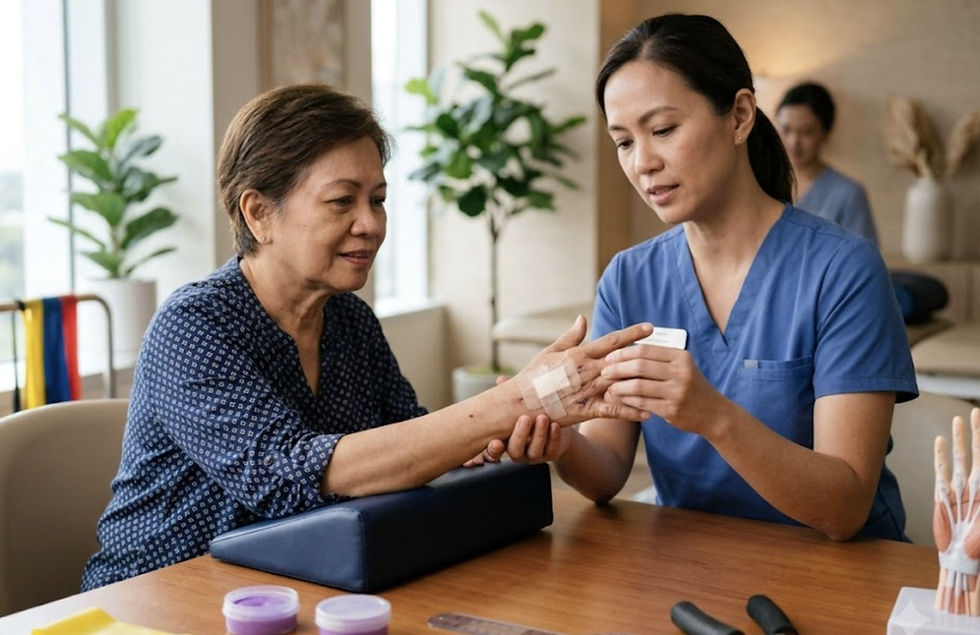
We record the exact bend at each joint and test how your hand performs on the tabletop. Those measurements become the yardstick for everything that follows.
Step 02
Matching the Method to Your Hand
We compare needle release, injection, and open surgery against your contracture pattern, your recovery timeline, and how much downtime your work allows.
Step 03
Releasing the Cord
Whether through a needle, an injection, or careful open dissection, the cord is divided or removed while the nerves and arteries running alongside it are protected with meticulous technique.
Step 04
Regaining Full Extension
Hand therapy begins early, paired with a night splint that holds the finger in its corrected position while the tissue settles.
Step 05
Watching for the Long Game
Dupuytren's can return, so we keep an eye on your hand over time and act early if new cords appear, rather than waiting until another deep contracture develops.
Your Questions Answered
FAQs About Dupuytren's in LA
Use the tabletop test. Place your palm flat on a table, and if it will not lie flat, book an evaluation. That threshold generally means a cord has developed enough to warrant treatment. Nodules that do not cause bending can often be monitored, though we recommend a baseline visit at our Los Angeles office.
Usually not. Some patients experience tenderness over a nodule in the early stage, and that discomfort often fades as the disease progresses. The concern is loss of function rather than pain, which is exactly why so many people delay care until a finger is significantly bent.
It depends on the method. After needle release, most people resume light tasks with their hand within a few days. Open surgery calls for stitches, wound care, and roughly two to six weeks before comfortable full use. Hand therapy and night splinting support recovery in both cases.
Yes, because the underlying tendency remains in the tissue. Minimally invasive methods carry a higher recurrence rate but a faster recovery, while open fasciectomy lasts longer with a longer healing period. We discuss these numbers honestly before you make your choice, and recurrence is treatable.
Stretching alone will not release an established cord. Therapy helps maintain motion, supports recovery after a procedure, and keeps neighboring joints healthy, so it plays a real role. Once a finger is measurably bent, though, the cord itself has to be divided or removed.
Yes. Our Tarzana office serves patients throughout Los Angeles, the San Fernando Valley, West Valley, and West LA. Call 818-578-3152 or submit the appointment request form, and our team will confirm your visit and walk you through what to bring for your first evaluation.
What Our Customers Say
Your Hand Will Not Straighten Itself
Every month a finger stays bent, the joint beneath it stiffens a little more, and stiff joints limit how much correction any treatment can deliver. The best results in Dupuytren's care go to the patients who get evaluated before the finger reaches the palm.
We accept new patients from across Los Angeles, the San Fernando Valley, and the West Side. Call 818-578-3152 or request an appointment online, and bring us the hand you want back.
Request an Appointment
Fill out the form below and our team will reach out to confirm your visit. Most fields are optional — we just need a name to get started.